Independent sourcing partner for Network Equipment. Factory quotations are compared only after radio, Ethernet, power, quantity, and destination are written on one sheet.

Bill of materials console

Industrial 4g wifi router briefs start with bands, ports, and power

LinkScope Sourcing 18 is an independent sourcing partner. An industrial 4g wifi router line is ready for factory quotes when the sheet names the LTE bands, the Wi-Fi frequency range, the MIMO layout, the Ethernet port speed, and the power input the cabinet can actually feed.

A catalog title that says 4G can still hide a single SIM, a missing band 28, or a 2.4 GHz radio with a 20 MHz channel width. Ask each factory which exact model, antenna connector, and firmware build the number is based on. A family photo is not that answer.

Request Factory Quotes
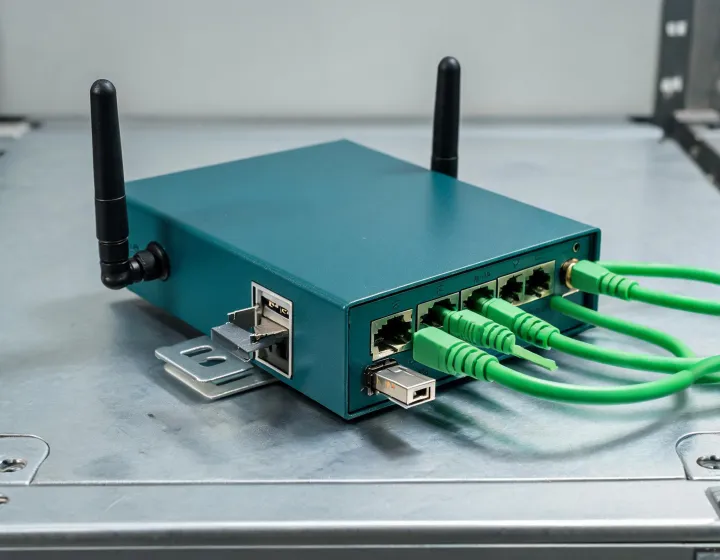
Industrial 4G wifi router on a telecom bench with a SIM tray and Ethernet leads
  • Interface: how many 10/100/1000 Mb/s copper ports, and is the uplink copper or SFP?
  • Radio: 2.4 GHz, 5 GHz, or both, and is MIMO 2x2 or 4x4?
  • Power: 12 V, 24 V, or 48 V DC, or Power over Ethernet on the WAN jack?
  • Host: which PLC, camera, or access point must stay reachable through the LAN?
  • Evidence: current datasheet revision tied to one manufacturer and model.

Lifecycle cells that belong on the first router sheet

Radio generation

Record LTE Category, such as Cat 4 or Cat 6, and whether 5 GHz Wi-Fi is in the same housing. A Cat 4 modem near 150 Mb/s downlink is a different spare plan from a Cat 6 modem near 300 Mb/s. Leave the figure blank if the sheet only says 4G.

Firmware window

Ask how long the proposed model receives security updates, counted in months from the quotation date, and whether a management license is required to download them. Local web management and a cloud seat are different line items.

Spare antennas

Write connector type, often SMA, and antenna gain in dBi for 700 MHz and for 2.4 GHz separately. A 5 dBi whip and a 2 dBi stub change both the link and the mechanical clearance inside a cabinet.

Replacement path

Ask what the factory proposes when this exact model reaches end of sale. A pin-compatible successor is a question, not a promise. Routing features, VPN seat count, and the SIM form factor must be rechecked on that successor.

A procurement scenario from a cabinet review, not a published saving: a US integrator comparing two industrial 4g wifi router offers in October 2026 wrote band 2, band 4, band 12, and band 13, plus two Gigabit LAN ports and 24 V DC. One offer priced a unit whose second radio was 2.4 GHz only, channel width 20 MHz, MIMO 1x1. The other named 2.4 GHz and 5 GHz, channel width up to 80 MHz, and MIMO 2x2. The desk did not choose a winner. It stopped the buyer from treating the two headline prices as the same radio.

Deployment routes that change the bill of materials

Cabinet and DIN rail

A metal enclosure with a DIN clip, ingress protection such as IP30 inside a cabinet, and a temperature window the supplier must state, for example -20 C to 70 C. Switching capacity on the LAN side still needs a number. Four Gigabit ports, full duplex, are 8 Gbps if the claim is non-blocking. Forwarding rate near 1.488 Mpps per Gigabit at 64-byte frames is the cell to confirm, not to assume.

Vehicle or trailer

Power input may be 12 V with ignition sense, and the antenna may leave the housing on a low-loss lead. Impedance is usually 50 ohm. Gain and the cable loss at 1800 MHz belong on the same line so the radio and the antenna are not priced as if the lead were zero metres.

Small site with cameras

Power over Ethernet budget, if the router sources it, must name the standard and the watt total, such as 802.3af at 15.4 W per port or a lower total if the supply is shared. If the router only receives PoE, say so. A camera that needs 48 V and a router that only accepts 12 V are not the same power row.

Read the range inquiry cards when a seller quotes a kilometre, or the procurement brief for the same evidence columns in article form.

RFQ questions that keep two router offers comparable

Which document states the LTE bands?

Ask for the datasheet row that lists band numbers, not a region name such as North America. Band support is a limitation: a unit quoted for one operator plan can miss the band the SIM actually camps on. This desk does not certify the camp.

Managed features or a fixed radio?

A managed router can expose SNMP, VLAN, and a firewall policy, and it adds configuration time plus a possible license. An unmanaged or lightly configured unit can be enough when the only job is one SSID and one LAN. The managed versus unmanaged choice is a buyer trade-off. Visibility is useful when the site is remote. A fixed setup can be simpler when nobody will log in after install.

New unit or refurbished?

A new industrial router usually starts a clearer warranty and a firmware branch near the ship date. A refurbished unit can cover a discontinued enclosure when the seller names replaced parts, remaining licenses, and the support route. Condition is not assumed on this page.

What is outside the price?

Antennas, a 24 V supply, a DIN clip, a cloud seat, and the SIM are often excluded. Incoterm, currency, freight, and duties sit on separate lines. An EXW router-only figure is not the same total as a DDP figure that includes two antennas and a 12-month firmware window.
Send the router cells for a factory-quote review

Share bands, channel width, MIMO, port count, power input, quantity, destination, and requested timing. An optional target budget needs a currency and a per-unit or whole-order basis. A high-end, mid-range, budget, or undecided supplier preference is your stance, not a verified grade.

Three limits sit on every brief: radio range depends on path and regulatory EIRP, a license is not included unless the quote says so, and compatibility with a named PLC or camera is unconfirmed until the supplier ties it to one model.