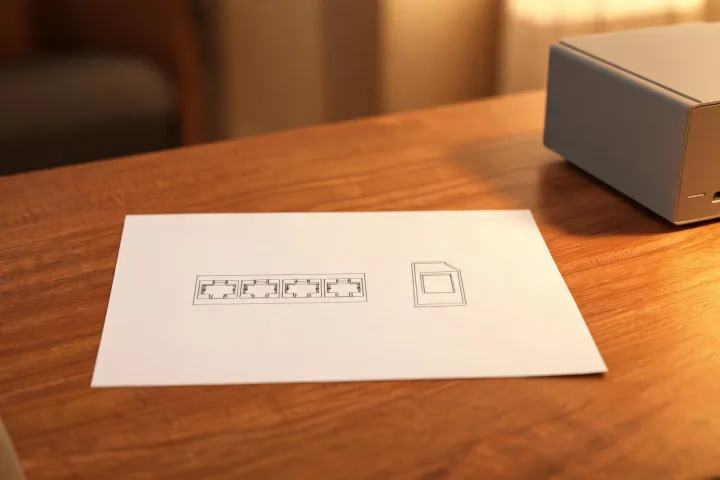
Cells the two-column form is built to hold
Left of the form is the reminder. Right of it is the actual submission. Keep the reminder in view while you type so a port map is not swapped for a slogan.
Interface questions come first: how many 10/100/1000 Mb/s copper jacks, whether an SFP cage is empty, and whether switching capacity is stated with a frame size. Four Gigabit ports, full duplex and non-blocking, are 8 Gbps only if the supplier says the fabric is that wide. Forwarding rate near 1.488 Mpps per Gigabit at 64-byte frames is a check, not a number this page assigns to your model.
Radio questions sit beside them. Frequency range for 2.4 GHz and, if present, 5 GHz. MIMO 2x2 versus MIMO 4x4. Antenna connector, often SMA, and gain in dBi if the antenna is in the same quote. Impedance is commonly 50 ohm when the antenna is bought separately. VSWR belongs on the antenna sheet, not as a router adjective.
Power and place: 12 V, 24 V, or 48 V DC, or Power over Ethernet as a source or a sink, with the watt figure. Ingress protection, such as IP30 in a cabinet or IP65 outdoors, changes the housing. Rack unit height applies only if you asked for a shelf or a 1U face.
A managed router can expose SNMP, VLAN, and a policy, and it adds configuration time plus a possible license. An unmanaged or lightly set unit can be enough for one SSID and one LAN. Neither choice is the default here. An OEM-coded radio may follow a platform vendor support rule. A compatible radio may widen the factory list only after it is checked on the exact host. New hardware usually makes the warranty start clearer. Refurbished hardware can cover a discontinued face if replaced parts and remaining licenses are named.
If an SFP is actually in the bill, say whether the plant is single-mode or multimode, and ask for wavelength and optical budget. If the path is cellular only, leave fibre off the sheet. Transmit power and regulatory EIRP limits are confirmation items. This desk does not issue an FCC grant and does not claim ISO 9001 for a factory it has not been shown evidence for.
Limits of the intake: a message does not reserve cartons, a datasheet family name is not a model, and a kilometre claim without frequency, antenna gain, and feeder loss is not a price basis. Read the price rows if the exclusions are still fuzzy, or the event planner if the job is a venue purchase rather than a cabinet.