Independent sourcing partner for Network Equipment. Factory quotations are compared only after radio, Ethernet, power, quantity, and destination are written on one sheet.

Event brief planner

Event wifi router for sale questions before a venue order is placed

An event wifi router for sale request is a purchase, not a hire list this desk fulfills from a warehouse. The planner turns load-in day, client count, and power into cells a factory can answer.

Prepare a Telecom RFQ
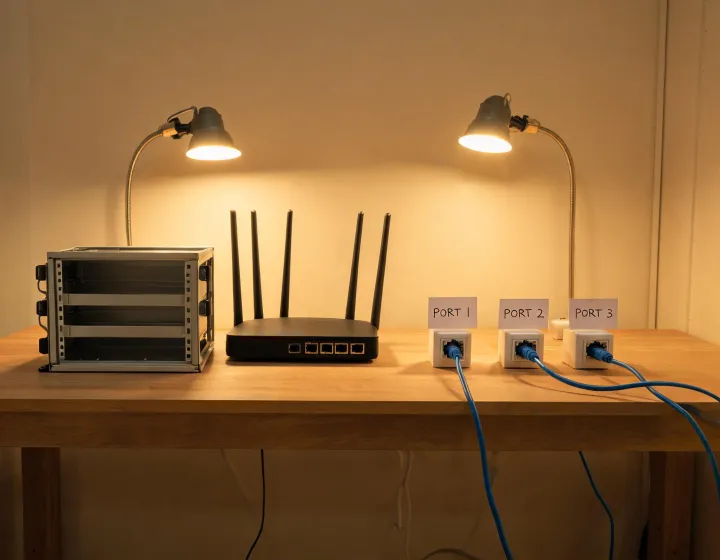
Temporary venue rack with an event wifi router and labeled Ethernet drops

Event timeline cells, not a sustainability scorecard

Load-in

Date, hall name, and whether the router must be on a table or in a 4U flight rack. Rack unit space, if used, is a number such as 1U. Channel width should be chosen before the hall scan: 20 MHz is often easier in a crowded 2.4 GHz room, while 40 MHz or 80 MHz on 5 GHz needs a cleaner slice. MIMO 2x2 is a common client match. MIMO 4x4 helps only when the clients can use it.

Show days

Client count is a buyer estimate, for example 80 phones and 10 point-of-sale terminals. SSID count, guest isolation, and whether a cellular failover is required sit here. Frequency range of the router must include the band the venue scan actually found free. Gain of any temporary antenna stays modest if the antenna is indoors and close to people.

Strike

Who keeps the unit after the show. A purchase means the buyer owns the configuration and the spare. A later event can reuse it only if the firmware and the license seat are known. This planner does not book rental stock.

Evidence to request

Datasheet page for channel width and MIMO, power draw at that state, and the Ethernet port speed feeding the access points. Switching capacity matters when several access points hang off the LAN. Ask for the frame size behind any forwarding rate. An IEEE 802 overview dated 2026-10-27 is only the LAN question list.

Trade-offs before you accept an event alternative

Integrated antennas or external?

Integrated antennas keep the kit small for a one-day hall and limit how far you can move the radio from the clients. External antennas on short SMA leads let you clear a metal stage, and they add connectors that can be left behind at strike. Impedance should stay 50 ohm on both ends. A seller that swaps a 9 dBi panel into a people-dense room may not have improved the design.

Cellular failover or a second WAN?

An industrial-style event router with one SIM can hold a show if the venue uplink fails, provided the LTE bands match the local SIM and the data plan is the buyer responsibility. A second Ethernet WAN avoids the radio license question and fails if both circuits share one building entry. Write which failure you are buying against.

New kit or a refurbished show router?

New kit makes the ship date and the accessory list easier. Refurbished kit can be appropriate when the show needs a discontinued flight-case face, if the seller lists battery or PSU replacements and the remaining firmware. Do not treat a scuffed bezel as proof the radios still meet the original gain figure.

A 2026 planner walkthrough used these numbers only as blanks to fill: 1 SSID for staff, 1 SSID for guests, 20 MHz on 2.4 GHz, 40 MHz on 5 GHz, 24 V or Power over Ethernet on the WAN, quantity 2 so one unit is a cold spare. One alternate offer dropped the second SSID license. The comparison paused until both offers either included that seat or marked it excluded. No winner was declared on this page.

Limits: a sale quote is not crew, channel planning on site still needs a scan, and client count is not throughput. Ingress protection is usually irrelevant indoors and becomes relevant if the router moves to a doorway. Optical budget is out of scope unless the venue handoff is fibre. Continue from the inquiry cards or jump to the form.
Put the event cells into one factory request

Load-in date, client estimate, channel plan, power, quantity, destination, and whether you are buying rather than hiring. Budget and supplier preference stay optional.